Sunday, 10 October 2010

Have Problems? Call These Numbers

MGP has been helping Mysoreans for the last 21 years to solve consumer, environmental and civic problems. Thousands of citizens have called MGP (2515150) to get advice on various issues. When they call MGP office, they are referred to one or the other of its members who help them.

To make this process shorter, MGP is now issuing directly to the media the names and contact numbers of its members who can help the public on various issues. This is a first list and additional names and contact numbers will be issued later.

The public is requested to keep in mind that the persons listed below will only guide the public on how to solve their problems, but will not in general take any action themselves.


C.V. Nagaraj (2521640): Food adulteration, packaged goods, spurious drugs

P.M. Bhat (2411673): Building bylaws, apartment-related laws.ΓΏ

Maj.Gen.(Rtd.) S.G. Vombatkere (2515187): Electricity, heritage, roads

Asha Vombatkere (2515187): LPG, PDS kerosene

H.R.Bapu Satyanarayana (2545077): Roads, transportation

V. Mahesh (98455 11109): Water, ground water

Syed Tanveeruddin.(98867 98191): Environmental protection, parks, street animals

Dr. K.A. Kushalapa (94480 58549): Tree cutting, environmental protection

Prof. S.K. Ananda Thirtha (99726 80588): Education related issues. environmental protection

B.V.Shenoy (93421 82884): Autos, RTI

P.S. Chandranna (94489 45747): Mysore City Corporation services

G.L. Nagaraj Urs (92439 99713): Property tax, consumer courts

Vasanthkumar Mysoremath (4243319): Mysore City Corporation services related to garbage clearance

Prof. S.Sobana (90199 93940): Education related issues

Prof. R. Chandra Prakash (2512180): Railways


PRESS Release by Sreemathi Hariprasad, President, Mysore Grahakara Parishat

Workshop on Global Warming

350.org is an international environmental organization whose goal is to build a grassroots movement to combat climate change. It takes its name from the research of NASA scientist James E. Hansen who theorized that if CO2 level in the atmosphere exceeds 350 parts per million, it could cause a global catastrophe. The increasing pollution worldwide has now pushed the level of CO2 in the atmosphere above this limit and 350.org is spearheading a movement to reduce the CO2 level to below 350 ppm. It is organizing a global "day of positive action on climate change" on 10-10-10. In this connection, MGP and the Institute of Engineers, Mysore Local Chapter are organizing a program at 10.10 AM on Sunday, 10-10-10 at the Institute of Engineers, JLB Road. Vasanthkumar Mysoremath, the 350.org organizer for Mysore District will give a power point presentation on CO2 emissions followed by a short film on the same topic.

V.Mahesh, Mysore Grahakara Parishat

Monday, 4 October 2010

Does Cholesterol Cause Heart Attacks?


The World Heart Day on 26-9-10 saw a spate of articles and advertisements in many newspapers on the various ways to prevent heart attacks. They were unanimous in advising the public to restrict their intake of saturated fats and reduce cholesterol levels to avoid heart problems.

But available evidence indicates that cholesterol may not be the culprit after all. There seems to be no correlation between cholesterol levels in the blood and the risk of heart attacks. In one of the largest studies ever conducted on heart patients (and published in the January 2009 issue of the prestigious American Heart Journal - AHJ), 137,000 patients hospitalized for heart attacks between 2000 and 2006 were studied. The results were surprising to say the least.

Blood cholesterol is of two types, LDL and HDL. LDL cholesterol is supposed to be bad and according to the guidelines of the U.S. National Heart, Lung and Blood Institute, a level of more than 130 mg. of LDL cholesterol per deciliter of blood is considered unhealthy. But in the AHJ study, 72% of the heart attack patients had less than 130mg/dl of LDL cholesterol, a level considered safe. Only a very small fraction of these patients should have had low levels of LDL cholesterol. Instead, almost three fourths of the heart attack patients had low levels of the "bad" cholesterol and should not have had heart attacks! So reducing LDL cholesterol levels does not ensure that the risk of heart attack is reduced!

It is likely that other popular theories about heart attacks are also wrong. A distinguished heart surgeon has also recently debunked these theories which have been accepted by the vast majority of the medical fraternity. According to Dr. Dwight Lundell, a heart surgeon who has performed more than 5000 open heart surgeries in more than a quarter century of practice (and a pioneer of the beating heart bypass surgery), doctors have not paid attention to the recent discovery that inflammation in the artery wall is the real cause of heart disease and not cholesterol (click here). As a result, doctors have been prescribing diets which exclude saturated fats and reduce cholesterol, contrary to medical evidence. These diets are not only not reducing the incidence of heart attacks, but are creating an epidemic of diabetes leading to increased expenditure, suffering and deaths.

Despite the fact that 25% of the population takes expensive statin medications and despite the fact that the fat content of the average diet is lower, more Americans will die this year of heart disease than ever before.

Statistics from the American Heart Association  show that out of a total current population of 310 million, 81 million Americans suffer from heart disease, 23 million have diabetes and 63 million have pre-diabetes. These disorders are affecting younger and younger people in greater numbers every year. Dr, Lundell says that these alarming numbers are a direct consequence of the diet changes recommended by the majority of doctors.

According to Dr. Lundell, cholesterol does not accumulate in the wall of the blood vessel and cause heart disease and strokes unless there is inflammation of the walls. Without inflammation, cholesterol would move freely throughout the body as nature intended. It is inflammation that causes cholesterol to become trapped.

Inflammation is the body's natural defense to protect it from irritants such as bacteria, toxins, viruses or even foods the human body was not designed to process (such as low fat diet and highly processed carbohydrates - sugar, maida wheat flour, etc.). Inflammation is necessary for wounds and infections to heal, but, if these irritants are allowed to repeatedly attack the body, they cause "chronic inflammation" which is harmful, causing diseases such as hay fever, arthritis, heart attacks and strokes. Chronic inflammation of the blood vessels allows cholesterol to become trapped in large quantities at these spots and block the vessels, leading to heart attacks and strokes.

Another cause of chronic inflammation of blood vessels and hence heart attacks and strokes is the production in the body of proteins known as cytokines. It has been found that too much consumption of omega-6 oils (such as groundnut oil, corn oil, sunflower seed oil) promote production of cytokines. To reduce the production of cytokines, one should increase the proportion of omega-3 oils (such as butter and ghee) in one's diet. Ideally, the ratio of omega-6 to omega-3 oils in one's diet should be 2:1 or 3:1. But most doctors discourage the use of butter and ghee and encourage the use of sunflower seed oil and corn oil. This has skewed the ratio of omega-6 to omega-3 oils in the average diet to 10:1 and in some cases 20:1. It is ironic that persons who skew their diets in favour of omega-6 oils to prevent heart attacks are just doing the opposite. They are increasing the risk of a heart attack because their bodies are now producing extra cytokines which cause chronic inflammation of the blood vessels which lead to increased heart attacks!

C.V. Nagaraj, Mysore Grahakara Parishat

UPDATE:(6-10-10) Our Press release Does Cholesterol Cause Heart Attacks? stated that butter and ghee were good sources of omega-3 fatty acids. This was based on a study published in Proc Nutr Soc. 2003 May;62(2):329-36 which found that milk from grass-fed cattle is an important source of omega 3 fatty acids. Based on this research, the Wikipedia article on omega -3 fatty acids says that a match-box size piece of cheese can provide 88% of the recommended daily intake of omega 3 fatty acids.

But Dr. M.N. Krishna Murthy, formerly of CFTRI, who is an expert in this field, says that milk available in and around Mysore is very low in omega-3 fatty acids and butter and ghee made from this milk contains less than 1% of these fatty acids.
Saturday, 25 September 2010

New Executive Committe For MGP

D.V. Dayanand Sagar, Secretary, Mysore Grahakara Parishat  (PRESS release)

The following were elected unopposed to the Executive Committee of Mysore Grahakara Parishat at its 21st Annual General Body Meeting held on 25-9-10:  P.M. Bhat,  R.Narayana,  Sreemathi Hariprasad,  V. Mahesh,  S. Sobana,  M. Jayaram,  D.V. Dayanand Sagar. These committee members met after the General Body Meeting and coopted  Asha Vombatkere to the Executive Committee.  The new office bearers of MGP were elected at this meeting:

Sreemathi Hariprasad (President),
V. Mahesh (Working President),
D.V. Dayanand Sagar (Secretary) and  R. Narayana (Treasurer).

Wednesday, 22 September 2010

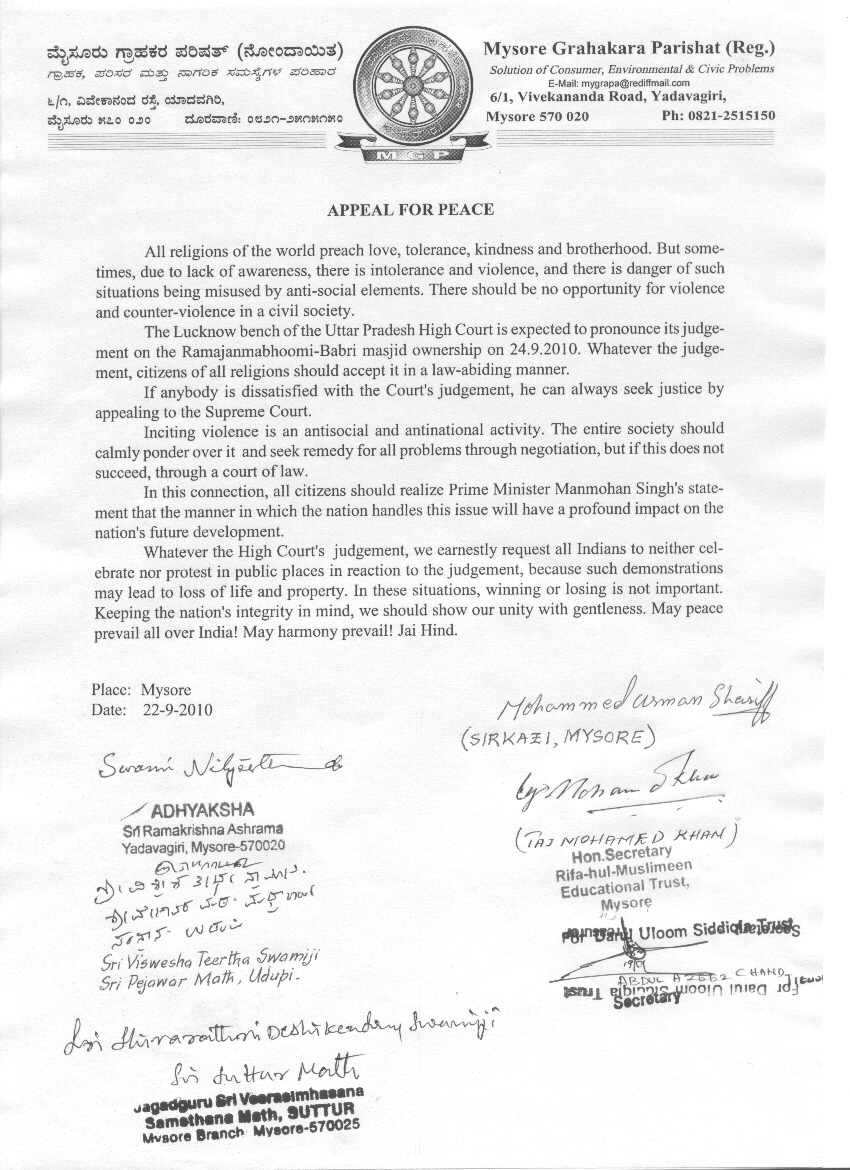
Peace Petition


Click on the image to enlarge it

Monday, 20 September 2010

Supreme Court Keeps Examination Boards Outside The Purview Of The Consumer Protection Act

During the 1990s, the Supreme Court gave several judgments which interpreted the Consumer Protection Act (and other consumer-related acts) liberally and greatly expanded the ambit of the Consumer Courts. This trend followed the Supreme Court observation "The provisions of the (Consumer Protection) Act have to be construed in favour of the consumer to achieve the purpose of the enactment as it is a social benefit oriented legislation" in the historic Lucknow Development Authority Vs. M.K. Gupta case (III(1993) CPJ 7 (SC)).

But now the pendulum seems to be swinging the other way and in several decisions, the apex court has reversed the earlier pro-consumer decisions given by itself and has even struck down pro-consumer provisions of the law. In a recent decision, it has removed examination boards from the ambit of the Consumer Protection Act (CPA). So if the examination board loses the answer sheet of a student or for any other reason fails to publish his results, and he loses a year in the bargain, he can not now get compensation for the lost year. In fact, he now has no legal recourse at all against any acts of negligence by the examination boards.

In Bihar School Examination Board Vs. Suresh Prasad Sinha (IV (2009) CPJ 34 (SC)), the Supreme Court has held that examination boards are statutory bodies which do not offer any "service" to the candidates and the examination fees paid by the student is not a consideration for availment of service, but charge paid for the "privilege of participation in examination". The order of the Supreme Court overturns the order of the Patna District Forum (which had been upheld by the Bihar State Consumer Commission and the National Consumer Commission).
B.Vaikunth Shenoy, member, Mysore Grahakara Parishat

Sunday, 19 September 2010

What Is Happening With KRS Road?

KRS Road, one of the main roads of Mysore, has been closed for traffic from Tharaasu circle to Dasappa circle for more than five months now. Despite the dislocation of all the northern bus routes and the tremendous hardship caused to the road users, there has been very little in the way of protests from the public.

Most people in Mysore are not aware of what exactly is going on and why there is so much delay in reopening the road. Here is what we have found.

The Railways are building a new bridge for the Nanjangud line. To accommodate this bridge, KRS road had to be lowered. But there were water mains running just below the existing road and they had to be lowered too. The water mains were just one foot below the road surface and the pressure of the road traffic above caused them to leak significantly. To solve this problem, the mains will be several feet below the new road surface to insulate them from the effects of road traffic. The lowering of the water mains and the road surface are the works that are going on now.

Now the cause for the delay. When they were in the process of lowering the water mains, they found one more main which were not prepared for. It is shocking that MCC did not know how many water mains there were below the road. These are not some half inch water pipes which could be laid by some unscrupulous customer without MCC knowing about it, but huge water mains which supply water to thousands of people. It is mind-boggling that MCC could not know about the existence of such a main.

Anyway, the surprise finding of an extra main has upset all the plans of MCC and is causinng the delay. But since the Dasara is almost upon us, and KRS road is a very important road, the pipe work is being suspended and the road filled up and brought to its original state . The road will again be dug up after the Dasara and the work completed. Needless to say, the filling and re-digging will cost cost a lot of extra money.

It is surprising that modern management techniques like Project Evaluation Review Technique (PERT) and Critical Path Method (CPM) are not being employed by MCC to manage any of its projects. These techiniques are used worldwide to cut costs and time.

Then there is the question of fixing the responsibility of this bungling. Will MCC identify the people responsible and punish them for causing time and cost overruns and causing extreme hardship to the citizens of Mysore?

Dr.Bhamy V. Shenoy, Convenor, Mysore Grahakara Parishat

Problem Near Kamakshi Hospital

Lane delineators were placed near Kamakshi Hospital to mark the busbay. It probably was not a good idea from the beginning. The lane delineators are now crushed and the debris pose a problem both to bicycles and pedestrians crossing the road (See photo). Since there is no enforcement, vehicles are parked in the bus bay and so the buses now stop in the middle of the road itself, posing problems to other traffic. The concerned authorities should remove the lane delineator debris immediately and smoothen traffic flow.

D.V. Dayanand Sagar, Mysore Grahakara Parishat